
Existence is a mathematical construct.
Learn it from the mathematics itself. The Arithmoí books, taught as courses: read them, hear them read aloud, watch their figures move, and check your understanding as you go.
Watch the book's figures
Arithmoí Book 1 explains with pictures as much as with equations. Here are three of them, moving; the Figures page has all eight, each with the pages that explain it.
Figure 1.1.3 · The group permutations
Three turns and three flips bring a triangle onto itself: six moves, the group D₃.
Part 1.2.2 · A point turning on the unit circle
A point turns on the unit circle; its height, drawn out as it turns, is the sine.
Figures 1.3.1 to 1.3.3 · The angles of a triangle
Add up a triangle's three angles: π on a flat surface, more on a sphere, less on a pseudosphere.
Where mathematics meets physics and metaphysics
The Arithmoí Foundation researches mathematics in all its branches and follows it where it leads: into the laws of physics and the oldest questions about existence. What it finds, it teaches to everyone who wants to understand, in books, in courses, in the library and, soon, with a tutor.
The Arithmoí series and the books that follow it: mathematics, physics and metaphysics, written to be studied, to read and to hear.
Courses grown from the books, at your own pace: figures that move, every part read aloud, questions to test yourself, a study plan, your progress.
The Arithmoí books and essays, open to every curious mind: Book 1 in full and the Foundation's essays and papers, on a phone or a computer, with no account.
The tutor Coming
Nous, an AI that has read the books: ask it about ontological mathematics, and it answers from them.
[The universe] cannot be read until we have learnt the language and become familiar with the characters in which it is written. It is written in mathematical language.
I hope that students and life-long learners will see mathematics in a new light and inspire those who wish to undertake the journey of self-actualization.
Making all attempts to cast aside mathematical bias is central to the approach of this undertaking, where embracing complex numbers and non-Euclidean geometries are the tools utilized.
Study Book 1 at your own pace
The Arithmoí School · Part 1.6.1, The Singularity
A lesson from the school: the figure moves with the book's words, and questions follow the part.
The Arithmoí School
- Book 1's 8 sections, part by part: 92 parts in all
- Proper maths and the book's figures, with short animations
- « Listen »: the book read aloud, part by part
- Questions after each part, with instant feedback
- Your progress, your notes and your study plan
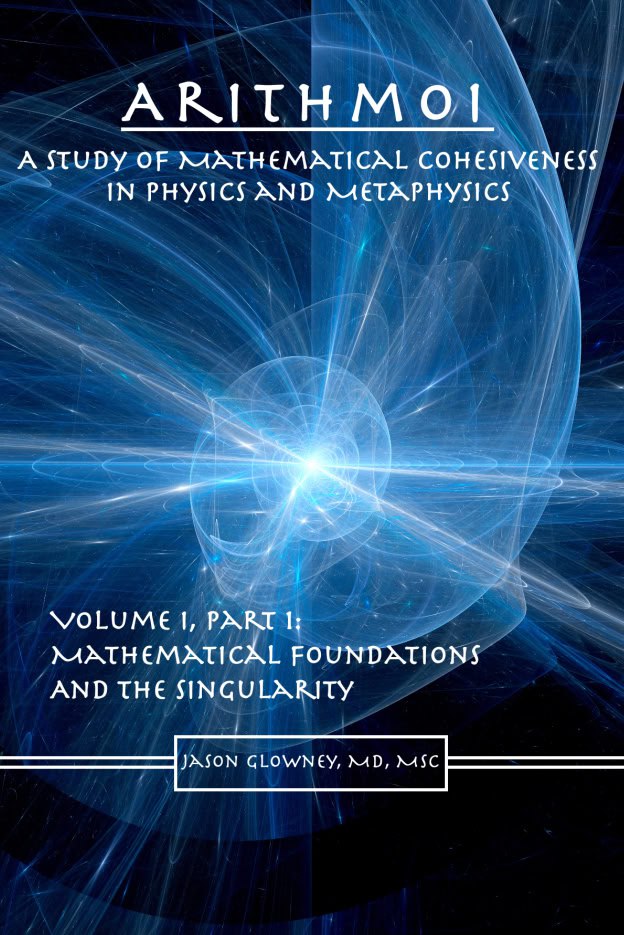
Arithmoí Book 1
Mathematical Foundations and the Singularity
Volume I, Part 1 of A Study of Mathematical Cohesiveness in Physics and Metaphysics
By Jason Glowney
The first book in a series studying existence as a mathematical construct, with mathematics as the means of conveying it: real, complex and harmonic analysis, group and Lie theory, topology and non-Euclidean geometry.
The AI chat
Ask the books a question
Nous is an AI trained on the Arithmoí books. Ask it about ontological mathematics: it answers from the books, and shows the section it draws from.
A small allowance without an account, more with one. In the school, Nous sits beside each lesson as the tutor.
An example question
What does Book 1 mean by a singularity?
Nous answers
It depends on the perspective. As an object, the infinite sphere of tangent spaces is continuous and well-behaved; seen with real analysis, it meets the criteria of a singularity. The book shows it with f(x) = 1/(x² − 1): poles at ±1 for real x, one continuous curve for imaginary x.
Book 1 · 1.6.1, The Singularity
The Arithmoí Library
23 works in four collections, open to every curious mind: Book 1 in full, and essays and papers from the Foundation, on a phone or a computer, with no account.